Forestry MulchingQuestions
What forestry mulching is, what it costs, what it can and cannot clear, and how to get an estimate in northeast Minnesota.
Everything People Ask Us
The basics
What is forestry mulching?
Forestry mulching is a way to clear land with one machine. A tracked loader carries a mulching head, which is a spinning drum with teeth. It grinds brush, saplings and small trees into mulch right where they stand. Nothing is piled, burned or trucked away. The mulch stays on the ground. Our guide to forestry mulching goes deeper.
What's the difference between land clearing and forestry mulching?
Land clearing is the goal. Forestry mulching is one way to reach it. The traditional method pushes trees over, piles them, then burns or trucks the piles. Mulching grinds the growth in place and leaves the soil and roots alone. We clear land by mulching only. See the side-by-side comparison.
What are the downsides of forestry mulching?
There are real ones. Stumps are left at ground level and the roots stay in the soil, so the ground is not ready for a foundation. Very large trees are a different job. Some species, such as aspen, willow and buckthorn, resprout from the roots or stump. The mulch layer takes time to break down, so you will not have bare dirt for seeding right away.
Is forestry mulching worth it?
If your goal is to open up overgrown ground and use it, the answer is usually yes. You skip the burn piles and the ruts, keep the trees you like, and the job is done when the machine leaves. If your goal is a dug-out building pad or stump-free soil, mulching is only the first step, and we will say so up front.
What does the ground look like afterward?
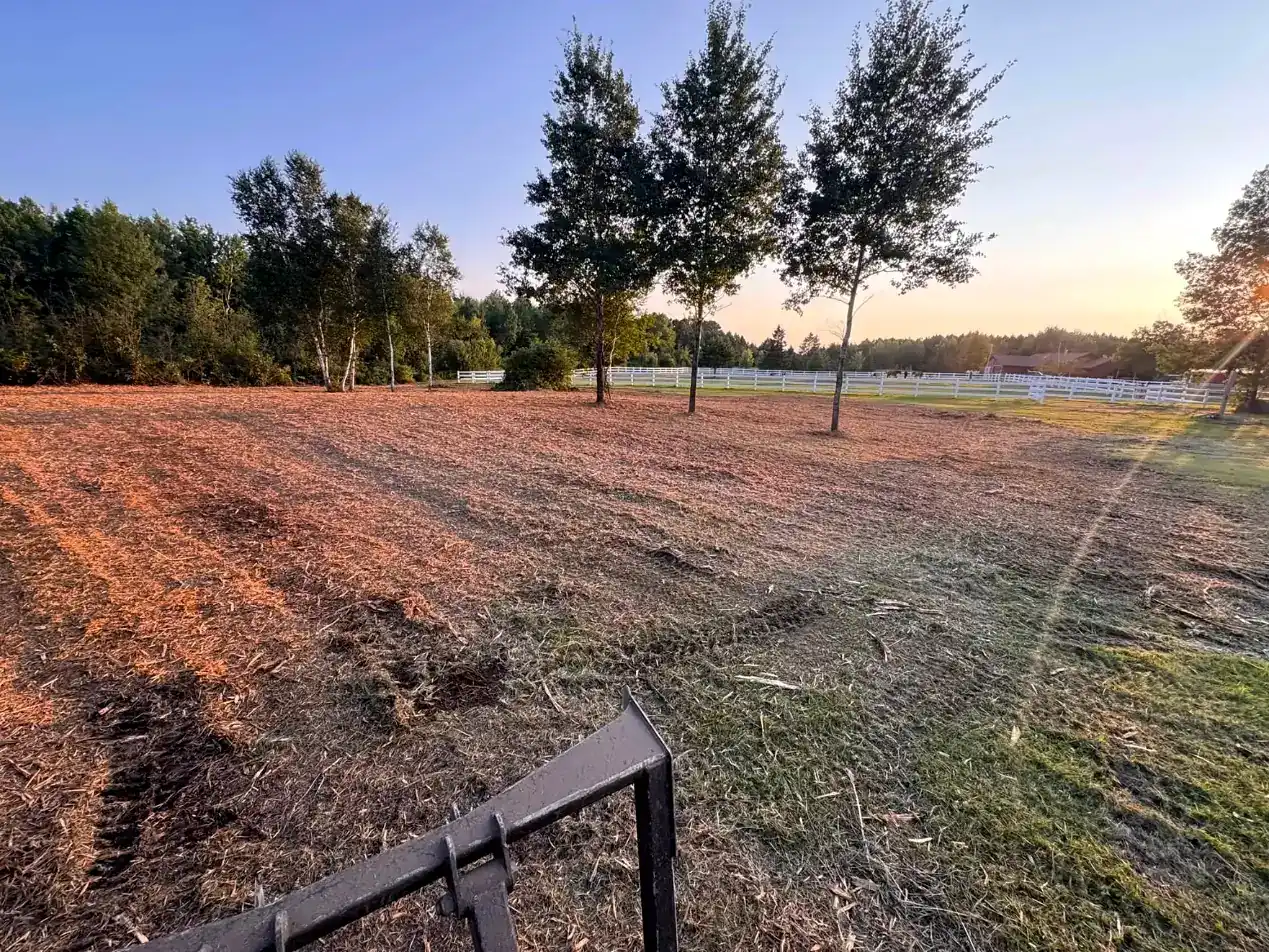
Expect a brown carpet of shredded wood chips and fiber over the soil, with the trees you kept standing in it. You can walk or drive across it. Stumps are cut close to the ground but still there. It does not look like a lawn on day one. The mulch settles and fades over the following seasons as it breaks down.
Cost and estimates
What is the average cost for forestry mulching?
An average would mislead you. Cost follows the density and size of the growth, the area, slope, wet ground, rock, access and how clean a finish you want. A thin stand on firm ground and a thick stand on a wet hillside are not the same job. The estimate is free. Our cost page walks through each factor.
How do I get an estimate?
Call or text (218) 461-7376, or use the form on the contact page. Tell us where the land is and what you want done. Calvin then meets you on the property and walks it with you before he gives you a number. The estimate is free and there is no obligation to book.
Can I text photos of my property?
Yes, and it helps. Text a few photos to (218) 461-7376 along with the nearest town or the county. Wide shots of the area and a close shot of the thickest growth are the most useful. Photos tell us if the job suits mulching. They do not replace the walk, because a camera misses slope, soft ground and rock.
What we can clear
How big of trees can a forestry mulcher take down?
A forestry mulcher is built for brush, saplings and small trees. That covers most of what chokes an overgrown lot, trail or field edge. We do not put a size number on it, because species, lean and what is nearby all matter. Large, mature trees are a different job for a tree service or logger. Calvin will point out which trees fall on which side during the walk.
Can you leave the trees I want to keep?
Yes. Selective clearing is a big part of what we do. Mark the keepers with ribbon or paint, or point them out on the walk. The machine works around them and takes the brush and saplings crowding them. You might keep your best pines, maples and birch and clear what is underneath. See brush and underbrush clearing.
What is the fastest way to clear brush?
For more than a small patch, a forestry mulcher is hard to beat. One machine cuts and grinds the brush in a single pass, so there is no dragging, stacking or burning afterward. Hand cutting with a saw or brush cutter works for a small area but leaves you with piles. On acreage, mulching finishes the whole job at once.
Will the brush grow back?
Some will. The mulch layer shades the soil and slows regrowth, but it does not stop it. Aspen, willow, alder and buckthorn can send up new shoots from roots or stumps. Mowing or brush cutting the area during the growing season keeps it open. Ground that gets no follow-up will slowly fill in again over the years.
Timing and seasons
How long does it take to clear an acre of land with a forestry mulcher?
No honest answer fits every acre. Light brush on dry, level ground goes fast. Thick growth, larger stems, hills, rock and soft soil slow things down, and a finer finish takes a second pass. We do not quote a time until Calvin has seen the land. After the walk he can tell you how long your job should take.
Do you work in the winter?
Yes. We work all year, and winter is a good season for it. Frozen ground carries the machine over soft areas with less rutting, and Calvin cuts trails and lanes in the snow. Very deep snow can slow or pause a job. Read more in our winter land clearing guide.
Can you clear wet or swampy ground?
Sometimes, with the right timing. Soft ground can rut or bog a machine in the warm months, so low areas are often best done when the ground is frozen or after a long dry spell. Wetlands also have rules about what can be cleared. Check with your county or the DNR first, then let us look at it.
Rules and practical stuff
Do you need a permit for forestry mulching?
It depends on where the land sits. Shoreland, wetland and local zoning rules can limit clearing in Minnesota, and the rules differ from one county and township to the next. Land near a lake, river or wetland deserves a phone call before any work. Check with your county zoning office or the DNR. Sorting that out before we arrive keeps the job simple.
Who do I call to clear land?
Call a contractor whose method matches the job. For brush, saplings, small trees, trails, fence lines and overgrown fields, a forestry mulching contractor is the right call. In northeast Minnesota, that is us at (218) 461-7376. If you need stumps dug out or dirt moved, you need a different kind of contractor, and we will tell you that honestly.
Still Have A Question?
Call or text (218) 461-7376 or tell us where the property is and what you want cleared. Calvin walks the land with you before you get an estimate.
- Free estimate after we walk the land
- Acreage, lots, trails and fence lines
- Rather talk now? Call or text (218) 461-7376