Brush Clearing ForDefensible Space
Defensible space is the area around a home or cabin where the fuel has been thinned, so a wildfire has less to burn and firefighters have room to work. Clearing brush, dead balsam and crowded young conifers is a large part of making it. Here is what Minnesota's Firewise guidance asks for and where a forestry mulcher fits.
What Defensible Space Means
The Minnesota DNR's Firewise program describes defensible space as space around a home that slows the spread of fire and gives firefighters a chance to protect the building. It is not a bare lot. It is a yard and a ring of woods with less in it to burn. The DNR's Firewise handbook puts the outer edge at up to about 100 feet from the home or cabin, with the closest attention on the ground nearest the walls.
The DNR counts more than 2,200 wildfires in Minnesota in a typical year, mostly in spring and again in late summer and fall. It says homes close to evergreens and tall grass are most at risk, and that embers and small flames are the main way homes ignite. That describes a great many cabins and rural homes in northeast Minnesota. Defensible space and brush clearing around a home or cabin are how an owner improves the odds.
The Zones Around a Home or Cabin
Firewise guidance works outward from the building in zones. The first is the few feet right against the walls, deck and steps. Nothing that burns easily belongs there. The next zone is the yard around the home, where trees and shrubs should be spaced out and kept clean underneath. The outer zone reaches into the woods, out to roughly 100 feet. There the goal is thinning, not removal. Fewer stems, less dead wood, and gaps that slow a fire down.
The first zone is hand work for the owner. Rake it, move the firewood, clean the gutters. A machine does not belong against a building. The middle and outer zones are where brush clearing comes in. That is where the balsam thickets, hazel, dead trees and low limbs are, and it is more ground than most people want to cut by hand.
What Brush Clearing Around a Home Removes
Fire climbs. The growth it climbs is often called ladder fuel. Brush, dead lower branches and small conifers under bigger trees carry flames from the ground up into the crowns, and a fire in the crowns is far harder to stop. The DNR lists reducing those vertical fuels, thinning stands and removing trees among its Firewise practices. It also notes that most evergreens carry volatile oils, and that deciduous trees and shrubs have more fire-resistant traits.
In northeast Minnesota the usual target is balsam fir. It grows thick under popple and birch, holds dead branches nearly to the ground, and where budworm has been through, much of it is already dead. See our guide to clearing dead balsam fir after spruce budworm. Our brush and underbrush clearing takes out that layer and leaves the trees you choose. The same visit can widen a driveway that has closed in. That is access work, and it helps anyone get in and out, a fire crew included.
Where Forestry Mulching Fits and Where It Does Not
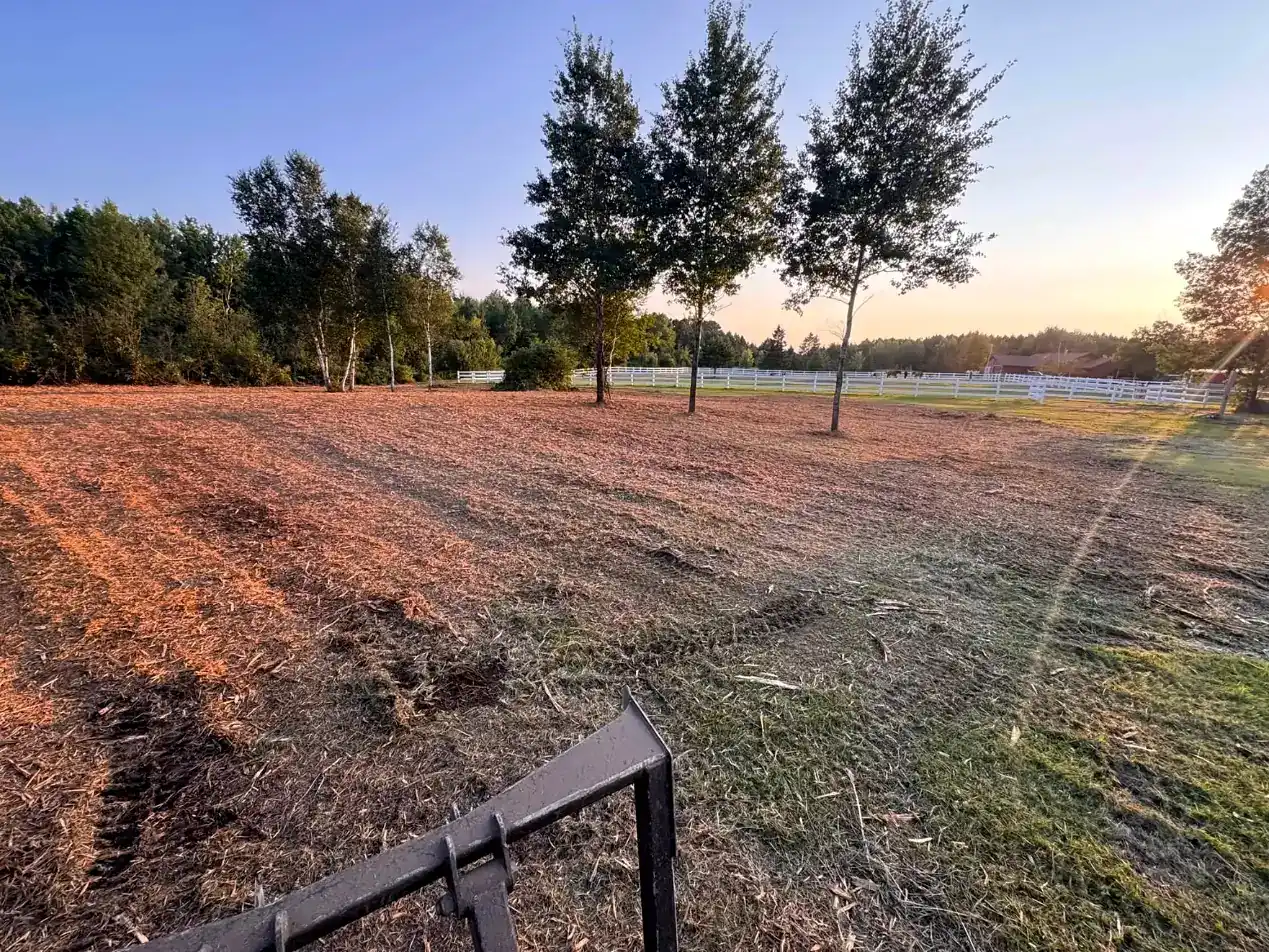
A forestry mulcher grinds brush, saplings and small trees where they stand, so no slash pile sits in the yard waiting for a burn permit. It works between the trees you keep. You decide how far out to go and which birch, maple, aspen and pine stay. It does not prune. Limbing up the trees that remain, cleaning the roof and trimming next to the house are jobs for the owner or a tree service. Large trees near a building are a tree service job too.
Be clear-eyed about the mulch. It is shredded wood, and wood burns. Spread flat on the ground it holds moisture and breaks down, and it is nothing like dry brush standing head high. But Firewise advice is to keep material that catches fire easily away from the home. So rake the chips back from the foundation, deck and steps after we finish, and keep that first strip bare or planted low.
Rules, Timing and Getting Started
Defensible space does not override other rules. On a lake or river lot, shoreland standards still limit clearing near the water, even when the reason is fire. Read clearing a lake lot under shoreland rules and ask your county zoning office how the two fit together on your lot. For an assessment of the home itself, start with the Minnesota DNR Firewise program or your local fire department. We clear brush. We do not rate a property or sign off on it as fire safe.
The work can be done in any season. Late fall and winter are good, because the leaves are down, the ground is firm and the place is ready before the spring fire season. Nothing we do makes a property fireproof. It lowers the fuel and gives a fire less to work with. To get a number, ask for a free estimate and Calvin will walk the ground around your buildings with you. See forestry mulching for how the machine works.
The Short Version
- Defensible space is thinned ground around a home, reaching out to roughly 100 feet.
- Brush, dead balsam and small conifers under bigger trees are ladder fuel.
- Mulching grinds that layer in place with no burn pile. Rake the chips back from the building.
- It lowers the fuel. It does not make a property fireproof, and shoreland rules still apply.
Quick Answers
How far from my cabin should brush be cleared?
Minnesota's Firewise guidance looks at the ground out to about 100 feet from the building, with the most care closest in. How far you go depends on the lot, the slope, the trees and your property lines. Calvin will walk it with you, and you decide the distance.
Does forestry mulching count as Firewise work?
It does the fuel reduction part: taking out brush, dead balsam and crowded small conifers and leaving spaced trees. It does not cover pruning, roof and gutter cleaning or anything about the building itself. Those matter just as much, and they are the owner's side of the job.
Is the mulch left behind a fire risk?
It is wood, so it can burn, but it lies flat against the soil, holds moisture and decays. It is far less of a hazard than standing dead brush. Keep it raked back from the house, deck and steps, and do not let it build up against anything that can catch.
Do you do wildfire assessments or cost-share paperwork?
No. We clear brush and small trees by forestry mulching. For a home assessment, or to ask about programs, contact the Minnesota DNR Firewise program or your local fire department.
Let's Open Up Your Land
Call or text (218) 461-7376 or tell us where the property is and what you want cleared. Calvin walks the land with you before you get an estimate.
- Free estimate after we walk the land
- Acreage, lots, trails and fence lines
- Rather talk now? Call or text (218) 461-7376