Clearing a Lake LotUnder Shoreland Rules
You can clear most of a cabin or lake lot in Minnesota, but not the strip next to the water. State shoreland rules restrict heavy clearing near the shore, on bluffs and on steep slopes, and your county or city enforces them. Here is what is generally restricted and who to ask before anything is cut.
The Short Answer for Cabin and Lake Lot Owners
Clearing a cabin or lake lot in Minnesota comes with one big condition. The ground closest to the water is protected. State shoreland rules prohibit intensive vegetation clearing in what they call the shore impact zone, in bluff impact zones and on steep slopes. Outside those areas, the state standards allow intensive clearing on a residential lot. So the back of the lot, the driveway and the building site are usually open to normal clearing. The shoreline strip is not.
That does not make the strip untouchable. The DNR's information for property owners says limited clearing and trimming of trees and shrubs is allowed there for certain purposes. Those are a view of the water from the main dwelling, and room for stairways, landings, lifts, picnic areas and access paths. What counts as limited is decided locally, lot by lot. Do not guess at it. A phone call costs less than fixing a mistake.
Who Writes the Rules and Who Enforces Them
The state writes the minimum standards. Local government adopts them into a zoning ordinance and enforces them. The DNR says so plainly: shoreland regulations are administered through local zoning, not by the DNR, and the office to contact is your local zoning authority, whether that is a city, a county or a township. The DNR also points out that a local ordinance may be more restrictive than the statewide standards. Two lakes a few miles apart can have different rules.
For most rural lake lots that means the county. In St. Louis County, ask the county planning and zoning office, unless your lot is in a city or in a township that runs its own zoning, as some do. In Itasca County, ask the county zoning office, or the city if the lot is inside city limits. Give them the lake name and the parcel address. Lakes and rivers are classified by size and sensitivity, and the limits depend on the class.
What Shoreland Rules Generally Restrict Near the Water
Three areas get the attention. The shore impact zone is the band of land right along the water. The state defines it as half the distance of the structure setback, so its width depends on how your lake or river is classified. Bluff impact zones cover high, steep banks and the ground at the top of them. Steep slopes are a category of their own. In all three, the standards rule out intensive clearing. Roots and ground cover hold the bank and slow runoff before it reaches the lake.
Wetlands come under separate rules, and low ground on a lake lot can be wetland even when it looks dry in August. Ask about that in the same call. Also ask whether your plan needs a permit, and whether dead or storm-damaged trees near the shore are handled differently. We leave the figures out of this guide on purpose. They vary by lake class and by ordinance, and the office that enforces them is the only reliable source.
What Can Usually Be Cleared, and How Mulching Fits
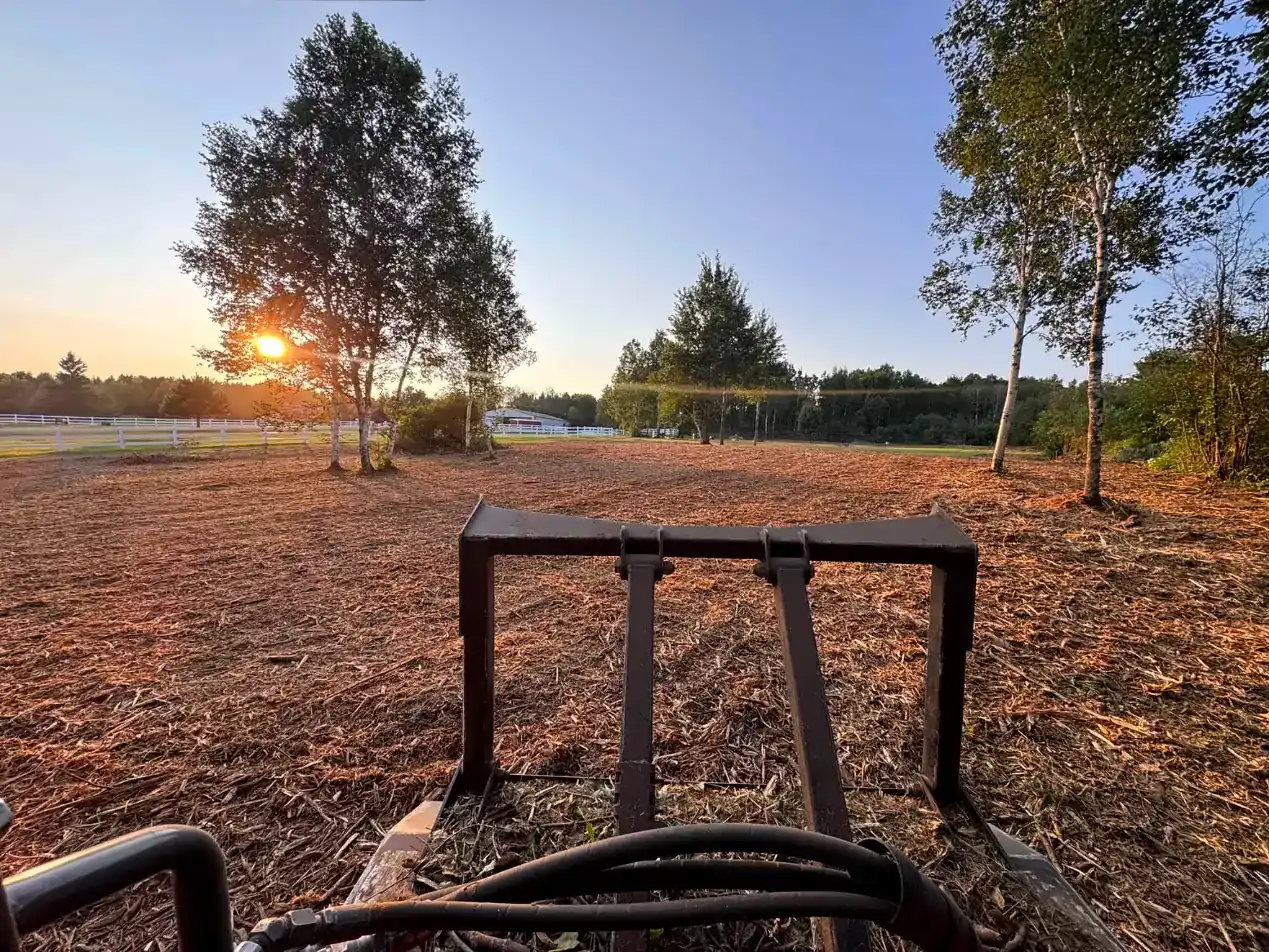
Back from the shore is where most of the work on a lake lot is anyway. The driveway that has narrowed until the boat trailer scrapes both sides. The building site for a cabin or garage. The yard that has shrunk as the brush crept in. Thick balsam and hazel crowding the buildings. That is ordinary lot and site clearing and brush and underbrush clearing, and a forestry mulcher does it with one machine, no burn pile and nothing trucked out past the neighbors.
Mulching suits lake lots for another reason. It is selective and it does not dig. The big pine, birch and cedar stay, the roots of what was cut stay in the soil, and a layer of mulch is left covering the ground. On a slope above a lake that beats bare dirt. Where your zoning office allows a path to the dock or limited thinning for a view, we can cut to exactly that and stop.
A Checklist Before You Call Us
First, call the zoning office and write down what they tell you, along with the name of the person. Second, know your lot lines, because lake lots are narrow and the neighbor's trees are close. Third, mark the trees you want kept, and flag the well, the septic tank and the drain field so the machine stays off them. Fourth, if the lot is leased or belongs to an association, find out whether the lease or the association has tree rules of its own.
Then ask for a free estimate. Calvin walks the lot with you, and you show him where the limits are. We are not the permitting authority and we cannot tell you what your county allows. We clear inside the limits you were given. To see where we work, look at the service area. If mulching is new to you, start with what forestry mulching is.
The Short Version
- State rules prohibit intensive clearing in shore impact zones, bluff impact zones and on steep slopes.
- Limited trimming for a view, access paths and stairways is generally allowed there.
- Counties, cities and some townships enforce the rules, and theirs can be stricter than the state's.
- Ask St. Louis County or Itasca County zoning before cutting. We clear inside the limits they give you.
Quick Answers
Do I need a permit to clear brush on my lake lot in Minnesota?
It depends on where on the lot and which lake. Clearing well back from the water is often allowed on a residential lot. Near the shore, on a bluff or on a steep slope, the state standards prohibit intensive clearing and allow only limited trimming. Your county or city zoning office will tell you whether your plan needs a permit.
Can I clear trees to get a view of the lake?
A limited view, generally yes. The state standards allow limited clearing and trimming near the shore to provide a view of the water from the main dwelling. They do not allow stripping the shoreline. How much is limited is a local decision, so ask before you cut.
Who do I call about shoreland rules in St. Louis County or Itasca County?
Call the planning and zoning office for the county your lot is in. If the lot is inside a city, or in a township that handles its own zoning, call that office instead. The DNR does not issue the local approvals, though its website explains the statewide standards.
Will you tell me what I am allowed to clear?
No. Only the zoning authority can say what applies to your lot. Once you know, Calvin will walk the property with you and plan the clearing to stay inside those limits.
Let's Open Up Your Land
Call or text (218) 461-7376 or tell us where the property is and what you want cleared. Calvin walks the land with you before you get an estimate.
- Free estimate after we walk the land
- Acreage, lots, trails and fence lines
- Rather talk now? Call or text (218) 461-7376