What IsForestry Mulching?
Forestry mulching clears brush, saplings and small trees with one machine and leaves the ground covered in mulch. Here is how it works, what you are left with, and where it is the wrong tool.
Forestry Mulching in One Sentence
Forestry mulching is land clearing done by grinding. One machine cuts the brush, saplings and small trees and shreds them into mulch right where they stand. Nothing gets pushed into a pile. Nothing gets burned. Nothing gets loaded on a truck. The shredded wood stays on the ground as a layer over the soil. When the machine leaves, the job is finished. That is the whole idea, and it is why the method suits owners of wooded acreage.
It helps to know what it replaces. The older method is to knock everything down, drag it into piles and deal with the piles later. That works, but it tears up the topsoil and leaves you with a second chore. Mulching skips the second chore. For a full look at how the two compare, read forestry mulching vs traditional land clearing. The short version: mulching is the gentler option for ground you want to keep in good shape.
How the Machine Works
The machine is a tracked loader carrying a mulching head on the front. The head is a heavy steel drum that spins fast and is lined with teeth. The operator lowers the spinning drum onto standing brush or pushes it into a small tree. The teeth chew the wood into chips and fiber and throw them down at the ground. A second pass over the fallen pieces grinds them finer and spreads them out evenly.
Tracks matter as much as the head. They spread the weight of the loader over a wide footprint, so it presses on the soil less than a wheeled machine of the same weight would. That is why a mulcher can cross firm ground without leaving deep ruts. It also turns in tight spaces. An operator can work around a tree you want to keep, clean out the brush beside it, and leave the trunk untouched.
What It Leaves Behind
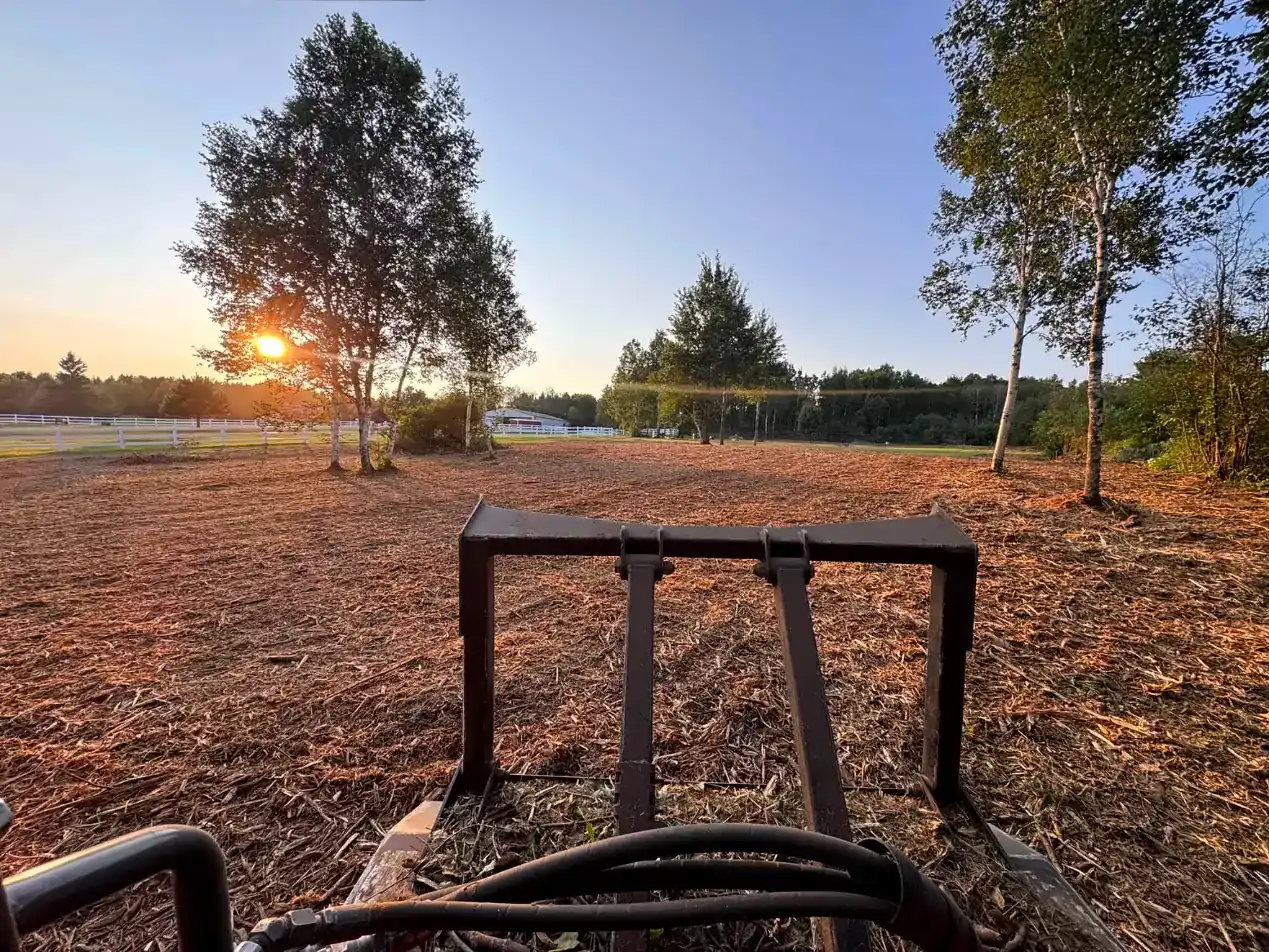
After a pass you have a layer of shredded wood over the soil. It looks like coarse brown mulch. You can walk on it, drive across it and see through the woods again. The layer shields the soil from rain, so there is less washing on slopes. It also shades out some of the seeds and sprouts waiting underneath, which slows regrowth. Over the following seasons it breaks down and becomes part of the ground.
Stumps and roots stay. The head cuts each stem off at or close to ground level, but it does not dig. Roots hold the soil in place, which is good for erosion and bad if you wanted bare dirt. The surface is not smooth like a lawn either. Expect short stubs, chips of different sizes and the natural lumps the land already had. For trails, pasture edges and woods, that finish is what you want.
Where Forestry Mulching Fits
The method suits most overgrown ground. It is how we handle brush and underbrush clearing under a stand of trees you plan to keep. It opens trails and access lanes without leaving slash on both sides. It cleans up fence lines and property lines so you can see and reach them. It takes back old fields that have grown in with willow, alder and aspen, which is hard to do by hand.
It also works well as the first step on a building lot. Lot and site clearing with a mulcher lets you see the ground, pick a house site and walk it with your builder. Hunters use it for shooting lanes, food plot openings and paths to stands. Because the clearing is selective, you choose what stays. The good trees keep standing and only the growth crowding them gets ground down.
Where It Does Not Fit
Mulching is not the answer to every job, and it is better to hear that before you pay for it. If stumps have to come out for a foundation, a driveway base or a septic field, another contractor has to dig them. If the ground has to be reshaped, that is dirt work, and we do not do it. Large, mature trees are also outside the range of a mulching head. Those belong to a tree service or a logger.
Some sites need care for other reasons. Rock at the surface is hard on teeth and limits how low the head can work. Standing water can stop a machine until the ground freezes. Land near lakes, rivers and wetlands may come under shoreland or zoning rules, so check with the county or the DNR first. Not sure where your property lands? Ask for a free estimate and Calvin will walk it with you.
The Short Version
- One tracked machine grinds brush and small trees where they stand.
- The mulch stays down, holds the soil and slows regrowth.
- Stumps are cut near ground level. Roots stay in the soil.
- It is not the tool for digging, reshaping ground or large timber.
Quick Answers
Does forestry mulching remove stumps?
No. The head cuts stems at or near ground level and grinds what is above it. The stump base and the roots stay in the soil. If you need stumps out for building, plan on a second contractor for that step.
Does the mulch need to be removed?
No. Leaving it is the point. The layer protects the soil and slows new growth, then breaks down over the following seasons. If you want to seed grass, the mulch may need time to settle first.
Can a mulcher work around trees I want to keep?
Yes. The machine turns in tight spaces and the operator controls where the head goes. Mark the trees you want, and the brush and saplings around them are cleared while they stay standing.
Let's Open Up Your Land
Call or text (218) 461-7376 or tell us where the property is and what you want cleared. Calvin walks the land with you before you get an estimate.
- Free estimate after we walk the land
- Acreage, lots, trails and fence lines
- Rather talk now? Call or text (218) 461-7376