Clearing Dead Balsam FirAfter Spruce Budworm
Spruce budworm is a native insect whose larvae strip and kill balsam fir. The dead trees dry out, break up and fall, and near a home or cabin the fix is to get them on the ground as mulch. Here is what is happening in the woods and what a forestry mulcher can and cannot do about it.
What Spruce Budworm Is
Eastern spruce budworm is the larva of a small moth, and it is native to these woods. It is not a new invader. The Minnesota DNR calls it the most destructive pest of spruce and fir forests in eastern North America. The larvae eat needles in early summer. They prefer balsam fir and white spruce, and they do lighter damage to black spruce, tamarack and some pines. From a distance a stand that has been hit looks scorched, with reddish brown tops where the new growth was chewed off.
It moves in waves. According to the DNR, an outbreak stays in one area for about eight years and then moves on, and thirty to forty years can pass before it returns. Northeast Minnesota has had budworm feeding somewhere in most years since monitoring began in the 1950s. The DNR places most of the current outbreak in northern St. Louis, Lake and Cook counties. That is why clearing dead balsam fir after spruce budworm is on the mind of so many cabin and woodland owners in that country.
How It Kills Balsam Fir
A tree can take a year or two of feeding. The DNR's advice for yard trees says healthy fir and spruce tolerate a couple of years of heavy defoliation, but after three or more years in a row they start to die. Balsam goes first. The top dies back, the needles that are left turn rust colored, and then the whole tree is gray. Where balsam grew thick under popple and birch, entire patches die together.
You cannot mulch your way out of an outbreak. What an owner can control is what stands near the buildings, the driveway and the trails. Look at your balsam in early summer, when fresh damage shows. Trees with green lower branches and a thin top are still alive. Trees with no green at all are finished, and they will not recover.
Why Dead Balsam Is a Fire and Blowdown Problem
Dead balsam is fuel. The DNR says trees killed by budworm create fuels that can add to the spread and intensity of a wildfire. Balsam holds its dead branches nearly to the ground, so a dry stand can carry a ground fire up into the crowns. The DNR also notes that a fir stand hit hard for five or more years in a row is a more severe wildfire risk five to eight years after the trees die. The danger does not pass when the needles drop.
The second problem is wind. Dead balsam rots quickly and does not stand for long. Tops snap off. Whole stems tip over in a storm and hang up in the trees beside them. Give it a few seasons and the patch is a tangle of crossed trunks with new brush growing through it. That blocks trails and driveways, makes the woods hard to walk and puts a deep bed of dry wood on the ground. It is also far harder to clean up than dead trees that are still standing.
How Forestry Mulching Deals With It
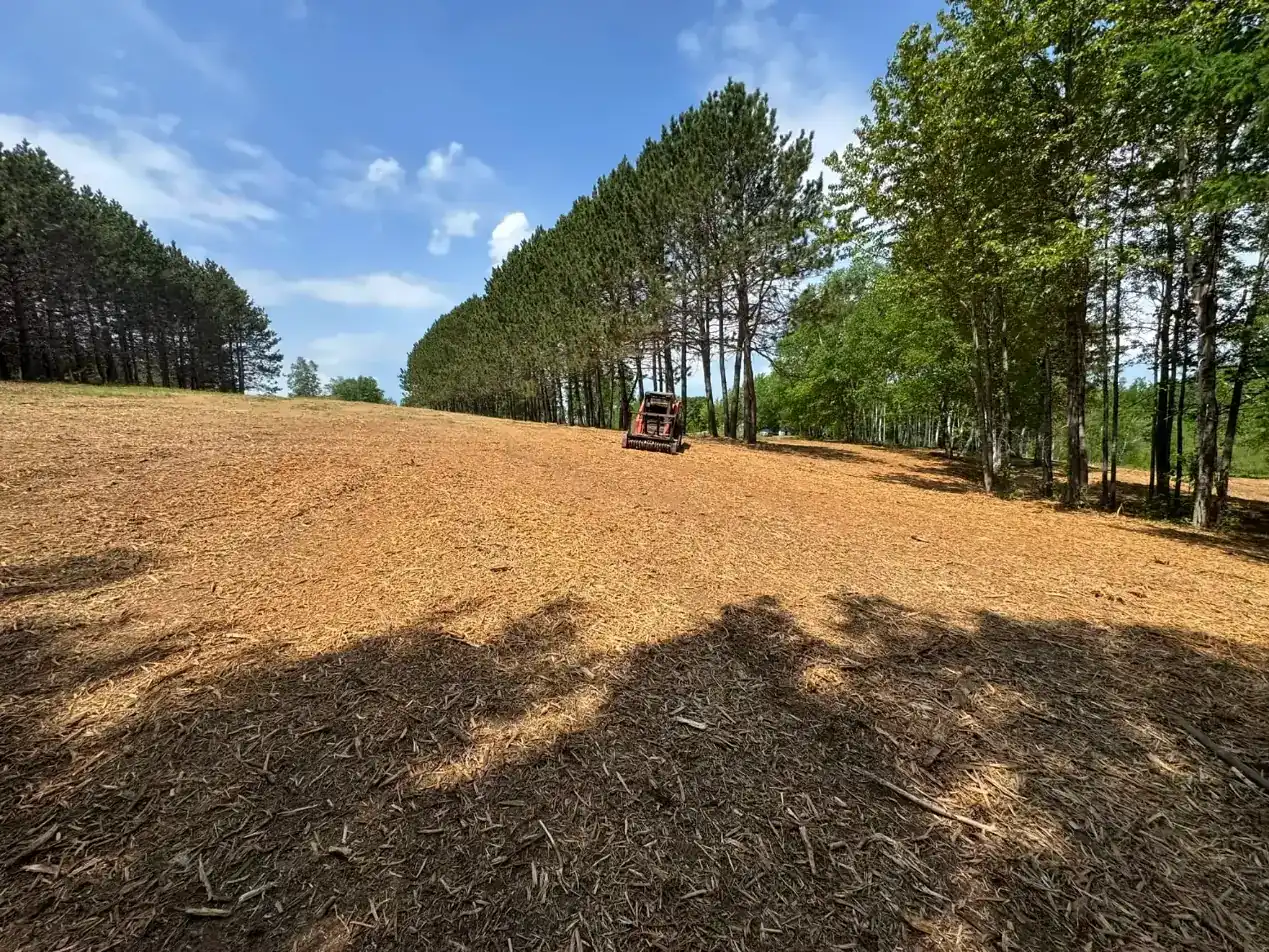
A forestry mulcher grinds dead and dying balsam where it stands. The mulching head chews the stem and limbs into chips, and the chips stay on the ground. There is no pile to burn, which matters when the whole point is fire. The work is selective. We leave the pine, spruce, birch, maple and healthy young trees you mark, and we take the dead fir and the brush between them. It is the same brush and underbrush clearing we do anywhere, aimed at one species.
The DNR says a clean-up that removes dead trees reduces the fire risk, and it advises favoring tree species other than balsam fir. Mulching does that on the scale of a home site, a cabin lot or a few acres of woods. It also reopens trails and access lanes that dead fir has started to block, and it is the first step toward defensible space around a home or cabin. Chips on the ground are still wood, but they lie flat, hold moisture and break down. That is a different thing from dry trees standing in the air.
Limits, Timing and What to Do First
There are limits. A mulcher is built for brush, saplings and small trees, and much of the balsam that dies under popple and birch falls in that range. Large dead fir or spruce, and any dead tree that could reach a house, a garage or a power line, is work for a tree service. Calvin sorts out which is which when he walks the property. Old blowdown is slower than standing dead trees, because trunks lying crossed on the ground are awkward for the head. Sooner is easier.
Dead balsam can be cleared in any season. Winter is a good fit, because frozen ground carries the machine into the low spots where balsam often grows. Before you call, walk the place and decide how far out from the buildings you want to go and which trees must stay. If the dead fir is close to a lake or river, shoreland rules may limit what can be removed, so check with the county first. Then ask for a free estimate, or read more about forestry mulching.
The Short Version
- Spruce budworm is a native insect that prefers balsam fir and white spruce.
- Three or more years of heavy feeding in a row can kill fir and spruce.
- Dead balsam is wildfire fuel, and it breaks up and falls before long.
- Mulching grinds dead balsam in place with no burn pile. Big hazard trees need a tree service.
Quick Answers
Can a forestry mulcher take down dead balsam fir?
Yes, when the trees are small enough. Dead and half-dead balsam grinds easily, and thick patches of it suit a mulching head. Large dead trees, and any tree that could hit a building or a line, should go to a tree service. Calvin will tell you which are which during the free walk-through.
Is it better to clear dead balsam while it is still standing?
Yes. Standing dead trees feed into the head cleanly. Once they blow down and pile up across each other, the work is slower and the result is rougher. If you can see that a patch is dead, there is no benefit in waiting.
Will my balsam come back after budworm?
Trees with no green needles left will not. Young balsam usually seeds back in thick under the dead stand, which sets up the same problem later. The DNR advises favoring other tree species. Keeping your pine, spruce, birch and maple and keeping new fir thinned is the practical version of that.
Do you spray for spruce budworm?
No. We do not apply insecticide or herbicide. We clear brush and small trees by mulching. For questions about protecting live yard trees, the Minnesota DNR publishes advice for homeowners.
Let's Open Up Your Land
Call or text (218) 461-7376 or tell us where the property is and what you want cleared. Calvin walks the land with you before you get an estimate.
- Free estimate after we walk the land
- Acreage, lots, trails and fence lines
- Rather talk now? Call or text (218) 461-7376