Forestry Mulching vsTraditional Land Clearing
Both methods clear land. They leave very different ground behind. This guide compares mulching with the traditional push, pile and burn approach, and says plainly when each one is the right call.
Two Ways to Clear the Same Acre
The traditional method uses heavy equipment that pushes trees over, piles them and burns or hauls them. Roots and stumps come out of the ground with the trees. What is left is bare, loose soil and one or more large piles. Forestry mulching vs land clearing of that kind is a real choice, because mulching takes a different route. One tracked machine grinds the brush and small trees where they stand and leaves the chips on the ground.
Neither method is better in every case. They solve different problems. The push and pile approach gives you stump-free dirt that can be shaped and built on. Mulching gives you open, walkable ground with the soil left in place. The right pick depends on what the land is for. We only do the mulching side, so take that into account as you read. We have tried to describe the other side fairly, because some jobs truly need it.
Soil Disturbance and Erosion
Pushing trees over rips the root ball out and leaves a hole. Dragging the trees to a pile scrapes the topsoil along with them. By the end, much of the surface has been turned over. That is fine if the next step is a building pad. It is a problem if you wanted to keep the ground as woods, pasture or trail. Bare soil on a slope will wash in a hard rain until something grows on it.
A mulching head works above the soil. Roots stay where they are and keep holding the ground together. The chips land as a cover that takes the hit from rain and slows runoff. On hillsides, creek banks and sandy ground, that difference matters a great deal. It is one reason owners choose forestry mulching for land they plan to keep natural. The tracks can mark soft ground, but far less than ground that has been torn open.
Time and Steps
Count the steps. Traditional clearing means knocking the growth down, moving it, stacking it, then burning or trucking it. Burning depends on weather and on local burning rules, so piles can sit for a season. Trucking depends on having somewhere to take the material. After that, the torn ground usually needs to be smoothed before it can be used. Each step can involve a different machine or a different day on site.
Mulching is one step. The machine arrives, grinds, and leaves. There is no waiting on a burn and no pile sitting in your field over winter. For brush and underbrush, saplings and small trees, that usually makes it the quicker path from overgrown to usable. On a site with heavy timber the picture changes. Large trees are outside what a mulching head does, and they have to be handled another way before or after.
What Is Left When the Machines Leave
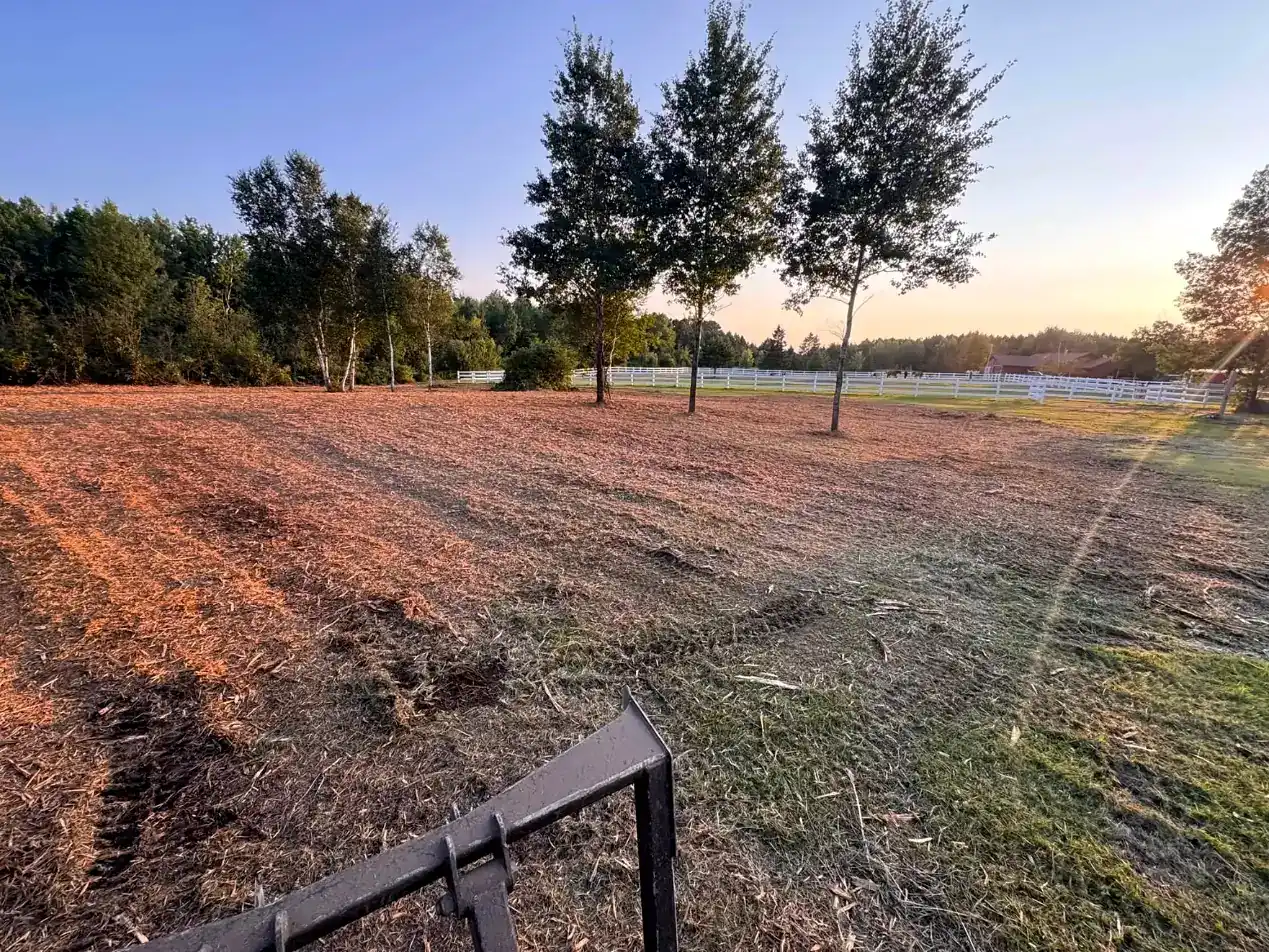
After traditional clearing you have open dirt, and often a burn scar or a leftover pile of stumps and roots. The ground is ready to be shaped. It is also ready to grow weeds, so it needs seeding or building soon. After mulching you have a brown layer of shredded wood, the trees you chose to keep, and stumps cut close to the ground. The site looks like tidy woods or a rough field, not a construction pad.
Selectivity is the other difference. A machine pushing trees needs room, and it tends to take everything in its path. A mulcher can thread between trees and clear only the understory. That is useful along a fence or property line, on a trail, or on a wooded lot where the mature trees are the reason you bought it. You decide what stays, tree by tree, before any of the work starts.
When Traditional Clearing Is the Right Call
Choose the traditional method when stumps must come out. A house foundation, a garage slab, a driveway base and a septic system all need ground free of stumps and roots. Choose it when the ground must be reshaped for drainage or a level pad. Choose it when the site is mostly large timber. We do not do any of that work. A contractor with digging equipment is who you want for it, and it is worth knowing that early.
Often the answer is both. Mulching first opens a building lot so you can see the ground, stake the house and decide where the driveway goes. Then the dirt contractor only disturbs the footprint that needs it, and the rest of the lot keeps its soil and its trees. If you are not sure which your project needs, get in touch. Calvin will walk the land and tell you straight.
The Short Version
- Mulching leaves roots and topsoil in place. Push and pile clearing does not.
- Mulching is one step. Traditional clearing has several, plus the piles.
- A mulcher can clear selectively around trees you want to keep.
- If stumps must come out or ground must be reshaped, you need the traditional method.
Quick Answers
Which method is better for erosion?
Mulching. Roots stay in the ground and the chips cover the soil, so rain has less bare dirt to move. Traditional clearing leaves loose soil that should be seeded or built on soon.
Can I build on land that has been mulched?
Not directly where the foundation goes. Stumps and roots are still in the ground and have to be dug out under a building. Mulching is a good first step to open the lot and plan the site.
Do you offer traditional clearing?
No. We clear by forestry mulching only. We do not pull stumps, dig or reshape ground. If your job needs that, we will tell you during the free estimate so you can line up the right contractor.
Let's Open Up Your Land
Call or text (218) 461-7376 or tell us where the property is and what you want cleared. Calvin walks the land with you before you get an estimate.
- Free estimate after we walk the land
- Acreage, lots, trails and fence lines
- Rather talk now? Call or text (218) 461-7376